

The best way to lower your CPA in Google Ads is to make changes that have the biggest impact first: eliminate wasted spend by using negative keywords from the search terms report, improve your Quality Score, improve your landing page conversion rate, and align your Smart Bidding strategy. Each point above the average (which is 5) is a 16% decrease in CPA.
If you manage a live ad account, you know that keeping costs under control is the difference between a profitable month and a paused campaign. The Google Ads auction is unforgiving. If you set your campaigns live and simply hope the algorithm optimizes itself, your costs will inevitably inflate. You do not need a massive budget to succeed, but you do need strict efficiency protocols.
What CPA is, and what “good” looks like
A good CPA is the CPA you can pay and stay profitable. You set it against your average order value or lead value, not an industry myth or a generic benchmark.
CPA is your cost per acquisition. It represents the actual amount you pay to generate one conversion, whether that is a form fill, a phone call, or a product sale. Do not confuse it with CPC. CPC is the cost of a single click; CPA is the cost of a finalized conversion. You lower CPA by turning more clicks into conversions for less total spend.
If you want a deeper dive into the foundational math and the relationship between these metrics, you can review exactly what CPA is and how to improve CTR.
A “good” CPA is entirely contextual to your specific business model. A 500 AED cost per acquisition is catastrophic if you sell a 100 AED consumer product, but it is incredibly profitable if you sell 50,000 AED consulting retainers in Dubai. You define your break-even point first, then you optimize the account to beat it.
Why your CPA is high – the usual causes
Your CPA is typically high because your ads are getting clicks for traffic that’s not relevant, or you have a low Quality Score from your landing page not converting.
The issue is not usually the Google Ads algorithm, it’s usually the cost per acquisition problem. It stems from the inputs you feed the platform. A high CPA means that you are paying for traffic that doesn’t convert, or you are paying a lot more than you need for traffic that does. When you don’t use negative keywords to suppress broad match keywords, Google will target your ads to low intent searches that are loosely related to your site, which will waste money.
Always look at your native auction data to determine if competitors are bidding on your ad, before pulling up your campaign structure. If your impression share remains stable but your CPA climbs steadily, you have an internal efficiency problem. You must systematically tighten your targeting and improve your ad relevance.
The fastest ways to lower CPA, in priority order
Do not attempt to fix every metric at once. The highest levers are the first to be pulled. In the sequence below, the focus is on speed-to-impact, that is a series of immediate solutions followed by compound gains.
1. Clean the search terms report and add negative keywords
Cleaning the search terms report lowers CPA because it immediately stops budget from bleeding into irrelevant clicks.
Do it by opening your search terms report, sorting by cost, and identifying queries that generate clicks but zero conversions. Look specifically for informational searches, competitor names, or unqualified terms. Add these directly as negative keywords.
Expect your overall click volume to drop slightly over the next week, but your conversion rate to rise. This drops your CPA almost instantly. This is the quickest and highest level action that you can take in any live account.
2. Raise Quality Score (ad relevance, expected CTR, landing page)
Google will bid more for relevant ads, thus reducing the cost per acquisition, the higher their Quality Score. Each point above the average of 5 Quality Score lowers CPA by around 16%.
Do it by aligning your keyword, ad copy and landing page with the same user intent. Create engaging headlines that align with the search query and increase CTR. Ensure that your landing pages are speedy, mobile responsive and deliver on their promise.
Please note that your base CPCs will gradually decrease over a couple of weeks. Lower CPCs mathematically leads to a reduction of your cost per acquisition as you are spending less and acquiring more traffic.
3. Improve landing-page conversion rate
When you increase your landing page conversion rate, you will get more leads from the same amount of money you spend on the ads, which means you won’t have to pay a higher CPA to get them.
Do it by repeating the pre-click promise in the post-click. If advertised, the first price the user sees in their browser window should be the AED price of a house service in Dubai. Get rid of distractions, make your primary call to action obvious, and shorten the loading time of your pages.
This optimization is expected to increase exponentially over time. If your conversion rate increases from 2% to 4% then the CPA will actually be halved without you needing to adjust any bids on the Google Ads interface.
4. Match the right bidding strategy (Target CPA / Smart Bidding)
Applying Target CPA lowers CPA because it allows Google’s machine learning to adjust bids in real-time based on the exact likelihood of a conversion.
Do it by switching your campaign to Target CPA only after the campaign exits the learning phase. You establish a goal and Google optimizes bids to reach the goal on average, after 30 conversions within 30 days of the campaign.
Expect initial performance volatility for the first week. Followed by this learning period, you will see a stabilized, lower cost per acquisition as the algorithm learns which specific user signals actually result in a conversion.
5. Tighten match types
The tighter you get on your match types, the lower the CPA will be because you won’t be able to have broad match keywords match to low-intent queries.
Do it by checking your keyword list and switching from low-performing broad match keywords to phrase match or exact match. Limit a broad match keyword if it has a high spend rate with low conversion rates.
Expect a noticeable decrease in overall impression volume. However, you will see a higher concentration of your daily budget spent on high-intent searchers who actually submit forms or make purchases.
6. Apply geographic and device bid adjustments
Applying bid adjustments lowers CPA because it stops you from overpaying for traffic in locations or on devices that historically underperform.
Do it by reviewing your location and device reports. If users on mobile devices in Sharjah convert at half the rate of desktop users in Dubai, apply a negative 50% bid adjustment to mobile traffic in Sharjah.
Expect your budget to automatically reallocate toward your most profitable segments, lowering your blended average CPA across the entire campaign.
A real before/after – cutting CPA in 60 days
To illustrate how these tactics work in sequence, look at the reality of account optimization. For a Dubai home-services account, we cut CPA from 240 AED to 85 AED in just 60 days. Crucially, 70% of that reduction came from negative keywords and a single landing-page rewrite, not from touching bids or algorithmic settings.
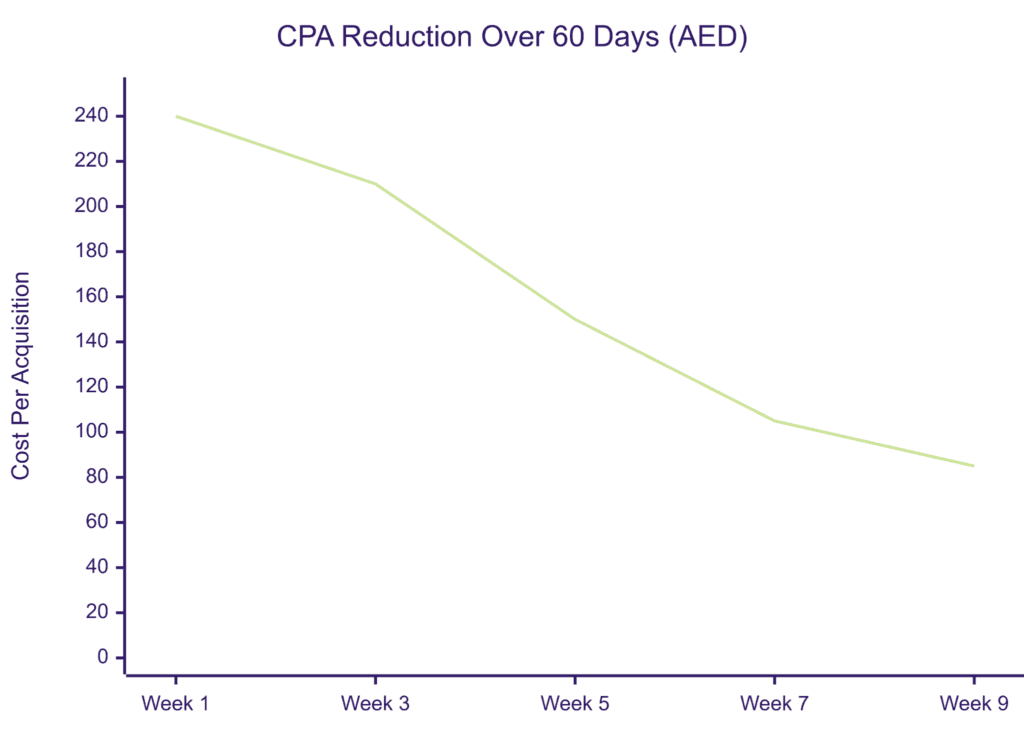
The 60-day timeline showing the impact of negative keywords and conversion rate optimization on total acquisition cost.
The mistake to avoid – starving volume to chase CPA
The biggest mistake advertisers make is setting their Target CPA too low, thereby depriving the campaign of volume.
Google stops competing in the auctions if you tell it to pay 10 AED for this conversion, which has historically cost 100 AED. You’ll no longer see any ads, your impression share becomes practically nothing and your lead count is depleted. You cannot force the system to give you leads below the actual market cost.
You must align your efficiency goals with market reality. When you set a realistic Google Ads budget, you must understand the floor of your market’s CPCs. You cannot dictate a CPA that is lower than the mathematical cost of acquiring the clicks needed to convert. Push aggressively for efficiency using the six steps above, but do not choke the account by setting impossible algorithmic targets.
FAQ‘s
What is a good CPA?
The CPA you can pay and stay profitable; set against your average order value or lead value, not an industry myth.
Why is my CPA high?
Usually wasted spend on irrelevant search terms, low Quality Score, or a landing page that doesn’t convert.
Does Quality Score affect CPA?
Yes, every point over the average of 5 Quality Score reduces CPA by approximately 16%.
How does Target CPA work?
You give Google a target; then once you have about 30 conversions in 30 days, Google adjusts bids to hit your target on average.
What is the difference between CPA vs CPC?
CPC is the cost of a single click; CPA is the cost of a conversion. You lower CPA by turning more clicks into conversions for less.
How fast can CPA drop?
Search-terms cleanup can move it within days; Quality Score and conversion rate optimization gains compound over weeks.