
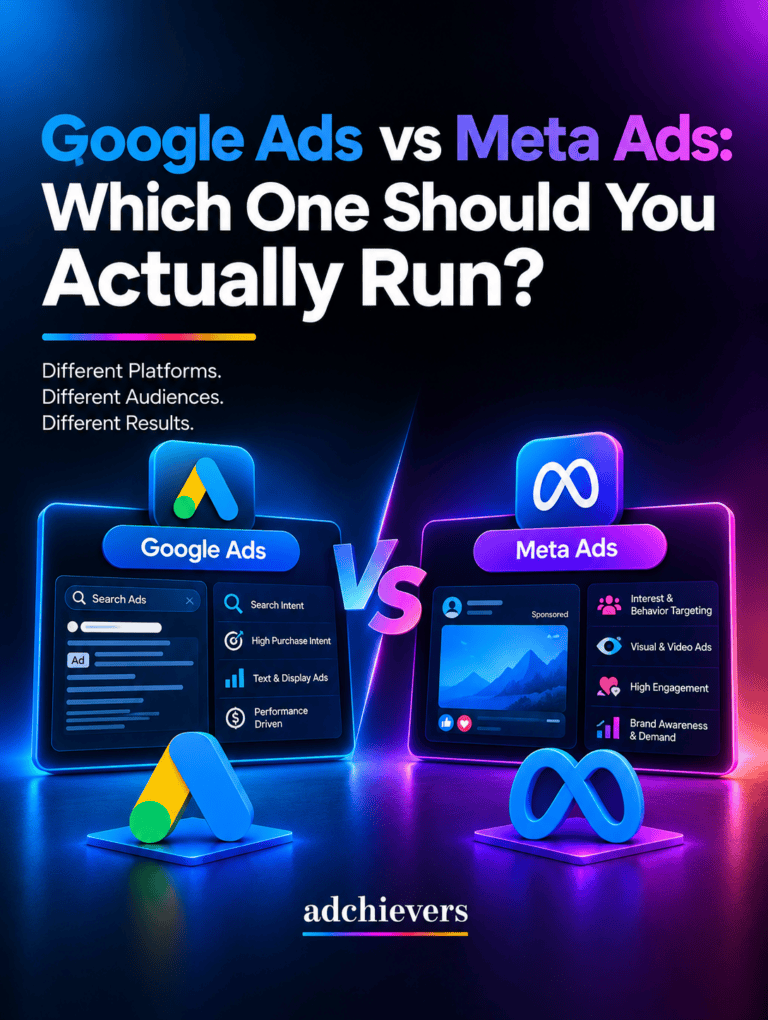
Google Ads is best at the bottom of the funnel where people are searching for products and services, while Meta Ads is best at the top of the funnel where people are looking for products and services by virtue of their interests or behaviour. For service and lead-gen, it’s usually Google; for visual and/or ecommerce, it’s often Meta; when budget allows, it’s better to use both, first Meta for brand building, then Google to drive conversions.
For the business owner, this is the most costly choice between Google Ads and Meta Ads. When you waste your money on the wrong platform, you waste your money on buyers who aren’t ready to purchase, or you overlook your potential buyers who actively look for your service. There’s no need to speculate. It will vary based on your business model, funnel stage and budget.
The one-line difference – and why it matters
Google Ads targets people who are looking for; Meta Ads targets people based on their interests and behaviour. This distinction dictates your entire marketing strategy.
When a user opens Google, they have a problem to solve. They type a specific query into the search bar. Google Ads serves an answer. You pay to capture that active intent.
When a user opens Facebook or Instagram, they want entertainment or connection. They are not shopping. Meta Ads interrupts their scroll with a compelling visual or hook. You pay to create demand that did not previously exist.
This fundamental difference means you cannot judge both platforms by the same metrics. A cheap click on Meta means your creative stopped a user from scrolling. An expensive click on Google means the user is ready to make a purchase today.
How each platform works
To make an informed decision, you must understand how each ecosystem functions mechanically.
Google Ads
Google Ads operates primarily as an intent engine. It encompasses Search, YouTube, and the Display Network. The core of the platform is the Search network. You target keywords with exact, phrase or broad match types. If a user types in those words, your text ad will be displayed first on the search results page.
They are at the bottom of the marketing funnel as they are self-serving the search. They have already decided on what they want. All you have to do is get them to buy from you, rather than your competitor. This high intent drives up the cost per click. Google Search traffic is always high converting and therefore advertisers are willing to pay a premium for it. You can then retarget these searchers throughout the internet via YouTube and the Display Network until they make their purchase.
Meta Ads
Meta Ads is the category of Facebook, Instagram and Audience Network (in what we call Facebook Ads). Meta operates as a discovery engine. There is no bidding on keywords. Rather, you are targeting audiences by demographics, interests and behavior, or you leave it to Meta’s algorithmic targeting to connect with the correct audiences.
Your creative is actually your targeting, in fact, on modern Meta Ads. The algorithm runs your video or picture through a wide audience, and then doubles down on the types of users that you’re attracting. The users are at the top or middle of the funnel, as they are passively browsing. Your ad should catch their eye, inform them of a problem and offer your product as the solution to that problem. Meta is usually cheaper to click through than Google, but it is likely to be more of an investment in traffic that will need additional nurturing.
Head-to-head – cost, intent, funnel, creative, measurement
The comparison below isolates exactly how the two platforms differ across core advertising dimensions. Always compare on CPA, not CPC. A cheap click that fails to convert is wasted spend.
The basic Google Ads vs. Meta Ads distinctions for intent, cost, and demand.
| Comparison Axis | Google Ads | Meta Ads |
| Search intent vs discovery | Captures active search intent. | Creates demand through passive discovery. |
| Funnel stage | Bottom funnel (closest to the sale). | Top and middle funnel (awareness and consideration). |
| Cost per click (CPC) | Generally higher due to purchase intent. | Generally lower, driven by creative engagement. |
| Cost per acquisition (CPA) | Often lower for high-intent services. | Variable; relies heavily on retargeting efficiency. |
| Audience targeting | Keyword-driven and query-based. | Interest-based, demographic, and algorithmic. |
| Creative demand | Low (text-based search ads). | High (requires constant video and image testing). |
| Measurement | Direct click-based attribution. | View-through and click-through attribution. |
| Time-to-results | Fast (captures immediate buyers). | Slower (requires audience nurturing). |
Which is better for your business? A decision framework
Do not rely on a generic recommendation. The correct platform choice depends strictly on your business type and budget constraints.
Service / lead-gen business
If you have a service or lead generation business, then go with Google Ads. People in the plumbing, legal, clinical, and B2B software industry resolve short-term issues. These services are sought out by users as and when needed. Google puts your phone number directly in front of a buyer who is ready to convert today. Your goal is to capture that existing demand and lower your cost per acquisition over time.
E-commerce
If you run an e-commerce brand selling visual or physical products, start with Meta Ads. The world of fashion, beauty and consumer goods is all about impulse buying and eye-catching marketing. Few users will search Google for a particular, unseen name of clothing brand. Meta’s algorithm excels at finding users whose browsing behaviour matches your product aesthetic. The creative does the selling before intent even exists.
Brand-building from scratch
If you’re bringing a new product to market that no one has heard of, opt for Meta Ads. If they don’t know what to put in their search bar then you can’t capture their search demand on Google. Meta allows you to educate the market, demonstrate the product visually, and build the initial wave of awareness.
Tight budget (start with one)
If you operate with a limited budget, you must pick one platform. Splitting a small budget across both platforms starves the algorithms of the conversion data they need to optimize. Choose the platform that matches your primary goal. Once that platform generates consistent profit, use the excess cash flow to fund the second channel.
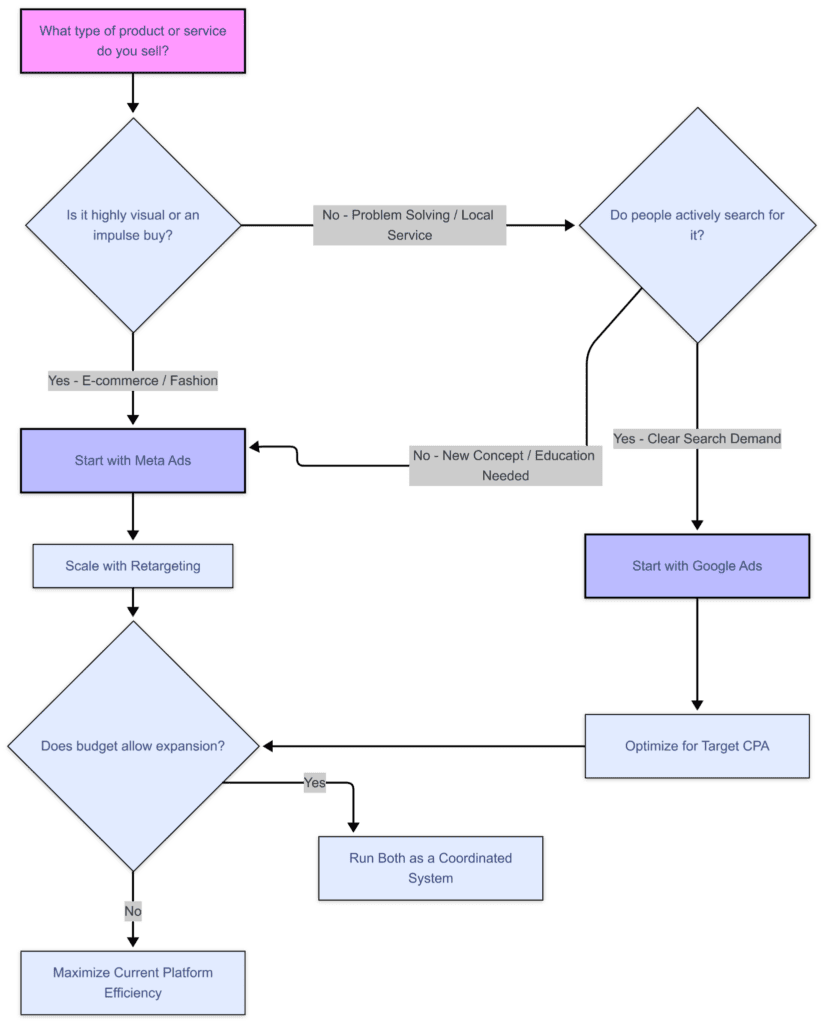
Follow this framework to determine which platform your business should launch first based on your product type and customer intent.
Should you run both, and how to split the budget?
Once you can fund both, yes – Meta creates demand at the top, Google converts it at the bottom. The strongest ad accounts do not choose between them; they treat them as a single ecosystem.
A coordinated strategy outperforms either platform running in isolation. You use Meta Ads to reach thousands of targeted users with a video demonstrating your product. A percentage of those users will remember your brand name but will not buy immediately. Days later, they open Google and search for your brand. Your Google Search ad captures that direct intent and secures the sale.
To split the budget effectively, start weighted to the platform matching your primary goal. If you are looking for immediate leads, give 70% to Google and 30% to Meta. If you must invest in the discovery of your e-commerce offerings, then allocate 70% of your budget to Meta and 30% to Google. During these first 60 days, you will be able to see data building that will allow you to shift your everyday budget to the platform that is providing the lower blended cost per acquisition.
What this looks like for UAE & Lebanon businesses
We see this dynamic play out daily across regional ad accounts. The Middle East market relies heavily on social discovery, making Meta a powerhouse for awareness. At the same time, the desire on Google in other cities such as Dubai or Beirut is costly.
Google provided bottom funnel leads, whilst Meta provided top funnel leads, and the combined CPA was better than either platform on its own for a Dubai home-services client. The client initially ran only Google Ads, paying roughly 45 AED per click for emergency repair terms. The conversion rate was exceptional, but the high CPC capped their overall volume.
We introduced Meta Ads to their media mix. We targeted homeowners in specific Dubai neighborhoods with educational video content. The Meta clicks cost only 3 AED. While the direct conversion rate from Meta was lower, the brand awareness skyrocketed. Within weeks, the client’s branded search volume on Google doubled. They acquired leads through cheap branded search clicks, significantly lowering their overall blended CPA.
In the Lebanese market, economic realities force businesses to be exceptionally disciplined with ad spend. In the case of Lebanese brands selling online and e-commerce, I often have a 70/30 split between Meta Ads and other platforms, with Facebook and Instagram being the leading storefronts. We then use Google Ads exclusively to drive quality brand search and product search with exact-match terms, so we don’t lose the last click to another competitor.
When you evaluate what Google Ads cost in the UAE and Lebanon, you must account for this synergy. Before you hire an agency for Meta ads management services, ensure they understand how to bridge the gap between social discovery and search intent.
FAQ
What’s the difference?
Always search Google first; because people are already searching for the service, you get your business at the forefront of the sale.
Which for a small service business?
Try Google first, since it attracts people who are already looking for the service, meaning your business is right in front of the sale.
Which for e-commerce / visual products?
Often Meta first. Discovery and creative drive demand for visual, impulse-friendly products before the user ever searches for them.
Cheaper platform?
Because Google’s intent tends to deliver a lower cost per conversion (CPA) while Meta’s cost per clicks (CPCs) are generally lower.
Should I run both?
Once you can fund both, yes; Meta creates demand at the top of the funnel, and Google converts it at the bottom.
How to split the budget?
Start weighted to the platform matching your primary goal, then rebalance toward the platform delivering the lower cost per acquisition.